My Participation in SWERC 2025
Publié le :
On the weekend of November 22-23, 2025, I had the opportunity to participate for a second time in the prestigious SWERC (SouthWestern European Regional Contest) representing INSA Lyon this year.
First of all, what is “SWERC”? The SouthWestern European Regional Contest is one of (if not the most) prestigious algorithmic programming competitions in Europe. It brings together the best universities and schools from France, Switzerland, Spain, Italy, Portugal and Israel. For 5 hours, nearly 140 teams of 3 compete (participating simultaneously on sites in Lyon, Lisbon and Pisa) on (very) complex algorithmic problems. More information on the official website.
Having had the chance to participate once already last year with my IUT, I thought that by joining INSA Lyon it could be nice to join one of the teams representing the school at SWERC. The first step was qualification within INSA Lyon: there are a total of 9 spots (3 teams of 3) to represent the school, and since more people are interested, a selection is mandatory. This selection is quite simple: a 2-hour “contest” on classic algorithmic problems from past competitions, and the top 9 from this contest are qualified.
During this selection, I initially placed 7th, but with several withdrawals, it was finally 2 teams that were formed to participate in SWERC, and I was going to participate in the second one. By my side, Jules and Ahmed qualified to form this team. The qualifications having taken place in mid-October, this left us about 1 month to train until the SWERC weekend.
To train, we were accompanied by Mathis Hammel, a former INSA Lyon student who regularly participates in competitions (I also see him at c0d1ngUP!). We met several times, online and in person, to try to solve problems from previous SWERC editions. On my side, I also (re)worked on several more theoretical themes (Arrays, Sequences, Graphs…) using the book Programmation Algorithmique - 128 algorithmes.
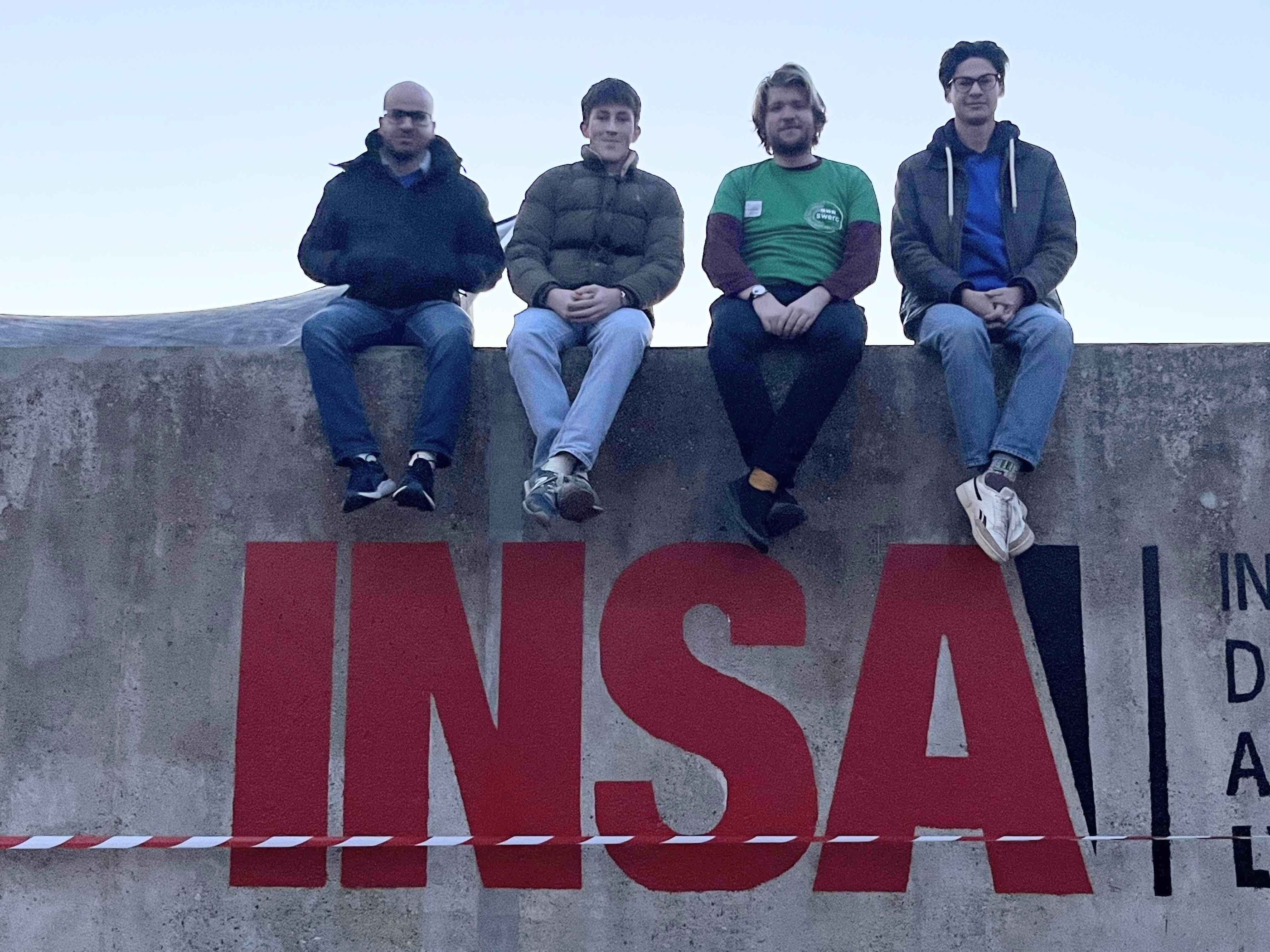 The team on the INSA wall. From left to right: Ahmed, Jules, Mathis and Nicolas.
The competition weekend unfolds as follows: welcome and team registration on Friday evening, technical conferences and sponsor presentations on Saturday morning, test session in the afternoon: test that the infrastructure works well, that teams can solve problems, print code snippets, ask the jury for clarification… In short, test that everything works! And this in view of the real competition which takes place on Sunday morning from 9:30 to 14:30, the weekend ending with the awards ceremony on Sunday afternoon.
Friday evening is also an opportunity to meet many participants, coaches, volunteers (including several I knew, since the event was taking place where I now have classes!). These meetings and exchanges are always very interesting, as are the technical conferences on Saturday morning that I was able to attend. Various topics were covered during this morning, but I especially remember the presentation by Timothée Lacroix, co-founder and CTO of Mistral AI, a French startup I’ve been following since its beginning! I also had the chance to exchange directly with him on Saturday evening during dinner, and it was a great experience! Among these meetings and exchanges, I was notably able to have my copy of the book Programmation Algorithmique - 128 algorithmes signed by the authors themselves who were present: Christoph Dürr and M. Jill-Jênn Vie, whom I thank again!
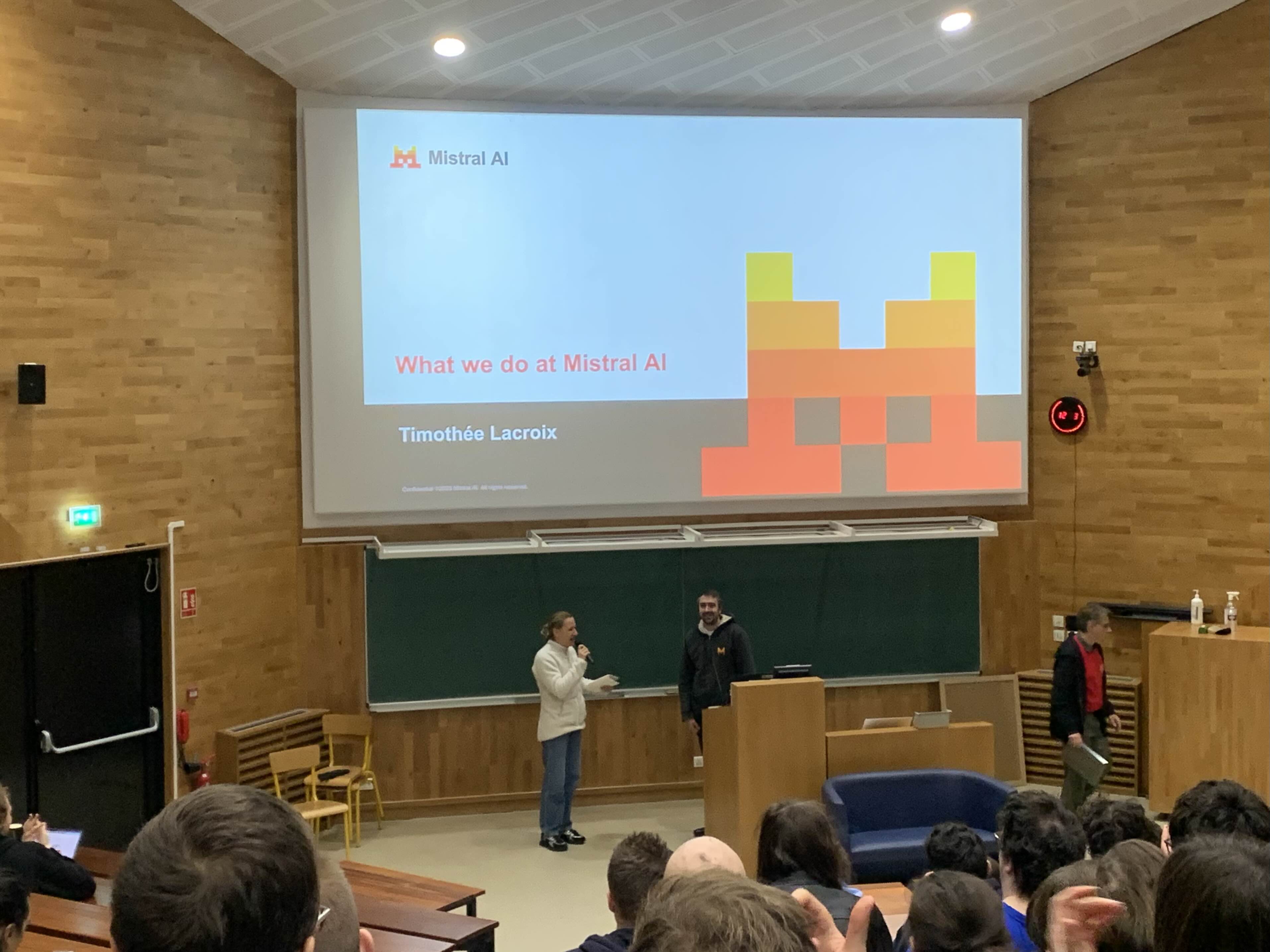 Timothée Lacroix’s Conference
Finally came the time of the competition on Sunday morning: a bit of stress, a certain pressure in the atmosphere, but very quickly the test launches and we start reading the 12 problems of the subject. We identify their difficulty levels, and we also look at the live ranking to spot the simple problems we can solve easily. In this way, I manage to solve a first problem quite quickly. Then we identify two other problems we can solve, unfortunately we spend a lot of time on these, but we still manage to solve them. Several hours have already passed, because we don’t realize it during the competition but time passes very quickly, and by thinking intensely in this way, we sometimes lose track of time!
Two new problems are within our reach but are no longer simple at all, we think about them for a long time and we end up solving one of the two during the last hour. This last hour during which the ranking is “frozen”, so that the suspense is kept until the awards ceremony. We are therefore at 4 problems solved, but we cannot unlock the 5th despite our efforts. On my side, I dig into another problem and on which, looking at the correction afterwards, I had the right intuition but I didn’t manage to go all the way. Thirty minutes before the end, we identify a simpler problem that we had missed, we try to work on it but time is running out and we finally finish with 4 problems solved.
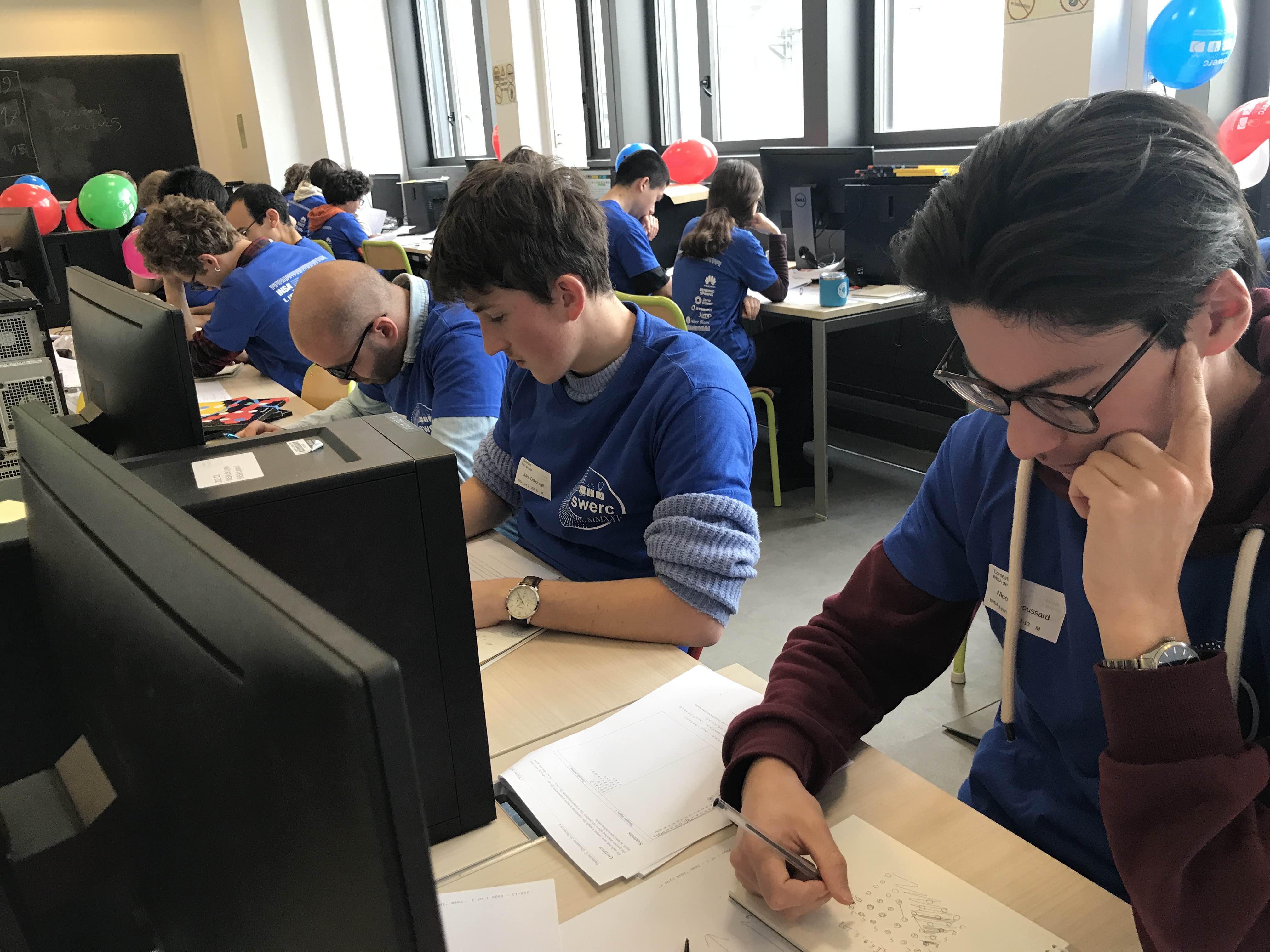 Our team during the competition
The ranking is calculated as follows: first, teams are ranked according to the number of problems they have solved, and then they are separated according to the total time they took to solve the challenges. During the awards ceremony, we start from the bottom of the table at the moment when the scoreboard is frozen one hour before the end, and we discover live the result of each solution submission to a problem during this last hour. This gives a very friendly atmosphere to the entire amphitheater, and Christof Dürr gets passionate at that moment about animating the display of results like a sports commentator! (See this video from last year’s replay, at 08:09:24)
We therefore arrive at 100th place out of the 142 teams present this weekend. Having finished in 107th place last year, I am a bit disappointed with the result of this participation, especially with my individual performance where I would have liked to perform better. But despite everything, I feel that I was more comfortable than last year, as evidenced by the intuition I had for a problem that was correct and for which I was not far from finding the solution. This gives me especially the motivation and desire to work more to perform better next year! I also want to mention and congratulate INSA Lyon team 1 who made a magnificent 18th place, notably qualifying for the European finals!
In the end, I am very happy, as in the previous edition, to have had the opportunity to participate in SWERC this year. It was a very good experience during which I learned a lot again, and which still makes me want to improve!